
The Anatomy of Stealth

A parts list, from someone who has had to build them
Every time I've pitched a stealth feature, somebody in the room has asked what a stealth game actually is, and the meeting has died there. It dies because the honest answer is that nobody agrees, and the dishonest answer "you know, like Metal Gear" will get you six months into production before anyone notices you were all imagining different games.
So here's the parts list. Not a taxonomy for its own sake. The organs, what each one is for, and what happens when you build it wrong, which I've done.
Furniture versus engine
The reason the definition fight never resolves is that stealth has two layers and everyone argues about the wrong one.
The furniture is the stuff you can point at. Vents. Vision cones. Patrol routes. Silenced pistols. The crouch button. Bodies you can drag. Grates, rafters, lockers, the cardboard box. Guards saying "must have been the wind." This layer is enormously recognisable and Cheap. You can install all of it in a sprint. This is why half the games shipping in any given year are stealth games for twenty minutes.
The engine is what the furniture is arranged around, and it's one sentence: you know where they are, they don't know where you are, and detection is reversible. The whole drama is the maintenance, loss, and recovery of that asymmetry. Every organ below exists to serve that sentence.
You can buy the furniture. You have to build the engine. And if you only buy the furniture, what you ship is a game that looks like stealth in a trailer and evaporates in the hand.
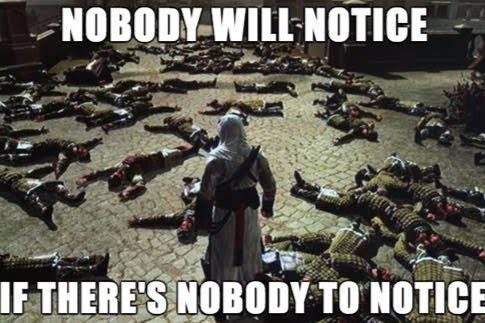
Test it on footage. Watch an Assassin's Creed stream: every piece of furniture the genre ever made, and the asymmetry is free to keep and worthless to lose, so nothing is happening. Watch anAlien: Isolation stream: no assassin, no gadget tree, no takedowns, barely any of the iconography, and the entire session is a fight over who knows where you are. One of those is a stealth game. It isn't the one with the hood.
---
The Eye
The oldest working part and the one people over-engineer first.
005, 1981, already had flashlight beams you hid from, which means the genre's founding idea was that enemy perception should be a physical object with a shape you can read. Everything since is refinement. Metal Gear gave it line of sight, hearing, and alert states in 1987. Metal Gear Solid put it on screen as a radar, which is still the most legible detection interface anybody has shipped, and which the series then spent twenty years walking back out of embarrassment. Thief went the other way and put the readout on your own body: the light gem tells you not what the guards see but how visible you are. Small difference, enormous consequence — it makes the player think about themselves as an object in the world rather than about the AI's internals. Splinter Cell lifted it straight into a visibility meter, which is why the early Fisher games are fairly described as Thief rewritten by Tom Clancy.
The cone itself accretes a fussy anatomy over time and you will rebuild this from scratch on every project. Tight forward cone for focus. Wider one for peripheral. Two stubs at the back for the over-the-shoulder glance. Then cover systems arrive, silhouettes stop being reliable, and detection becomes rays cast at bones on the skeleton, with the count of visible bones driving the response curve.
Which is my favourite fact in the discipline: the genre's central emotional experience, underneath, is a question of how many of your bones are currently visible.
Practical note. The eye is where new teams sink their first three months, and it's rarely where the game is failing. A crude cone in a good room outperforms a beautiful perception model in a bad one, every single time, and I have the playtest footage to prove it.
---
The staircase
The organ that separates a stealth game from a game with sneaking in it.
Metal Gear worked it out early: detection is a staircase, not a switch. He glimpses something. He's unsure. He's sure. Each step buys the player a window, and the windows are the game. Metal Gear 2 in 1990 added the back half: guards who stay up after losing you, keep looking, eventually stand down. Alarm as a process with a duration rather than a flag.
Bauer's rule here is absolute and I've come to agree with him completely: determinism. Randomise idle animations. Randomise barks. Randomise what he's grumbling about. Never randomise where he's facing. His argument is that randomisation in a stealth setup makes skill irrelevant in both directions at once, good players eat unlucky dice, bad players sail through on lucky ones, and nobody feels anything. And if you must randomise, give the player enough reaction time to respond to the outcome. His phrasing sticks: randomisation without reaction time is a low blow.
The version of this I've watched go wrong most often is the quick-turner. Linear back-and-forth patrol, player follows for the takedown, guard snaps 180 and lights him up. Bauer's fix is the one I now enforce: no linear patrols, circuits with at least three or four points, so that when the guard turns he isn't already looking at you and there's a moment to disengage. If you're stuck with a linear path, slow the turn down. That's it. That's the whole fix, and it costs nothing, and I've seen it ship broken in games with eight-figure budgets.
---
The reset
The organ nobody names in the pitch, and the one that actually decides whether you have a genre.
The game has to let you get back. Detection must be recoverable or the whole thing collapses into a save-load loop, and you can watch that collapse happen live on any stream , the moment a player starts quicksaving every four seconds, your stealth is dead and they're playing a different game with your assets.
Tom Francis's term for the useful range here is the failure spectrum: the states between total success and total failure. Metal Gear Solid V is the reference implementation and it's worth walking the chain, because every link is a design decision somebody had to argue for. Guard sees you, doesn't shoot, comes to look. Confirms you, and the game drops into a slow-motion window that hands you one chance to remove him. Miss, and he has to physically call it in, and you can stop him doing that. He gets the call out, and you can still run, still hide, still get back to black. Or fight. Or call a helicopter and stop pretending it's espionage.
None of that is forgiveness. Every link is a real loss of position. It's just that none of them ends the sentence.
The opposite pole is early Splinter Cell alarm sounds, mission fails, reload. That's a coherent design and it produces a real tension, but it's tension of the fingers. What it can't produce is the story: the one where it all went wrong and you got out anyway. Bethesda spent a paragraph of the Daggerfall manual begging players not to reload, telling them they'd never see the best parts of the game if they undid every mistake, and it was completely futile, because you cannot ask for that in a manual. You have to build somewhere for it to happen.
Here's the sting, though, and it's the whole third act of this piece: widen the spectrum far enough and success stops being distinguishable from failure. Then there's no reason to hide. We'll come back to it.
---
The body
Frail on purpose. This is load-bearing.
Mark of the Ninja gets described best by one of the essayists in that compendium: you're a magnificent ninja with a grapple and a dozen ways to kill in the dark, right up until someone sees you, and then you're a bloke in pyjamas with a knife and you have about two seconds. That frailty is what converts combat into a puzzle. Remove it and there's no argument for hiding, and no amount of scoring or achievement stickers will replace one.
Styx puts it in the model. Half the height of a man, deliberately, so the weakness reads in silhouette before he's moved. The devs said the size came from wanting to honour the older games and from realism, and it does double duty as a mechanic, because a body that small fits in pots and through grates and turns the level's void space into circulation the guards can't follow.
The narrative side of the organ is the same thing wearing a hat. Thief, spy, assassin, infiltrator, escaped prisoner: the genre keeps casting those roles for forty straight years because those are the professions of the physically outmatched. The role isn't decoration on top of the frailty. It's the frailty explained.
---
The kit
Most-abused organ, and Bauer nails the failure at both ends.
At one end: sections that need a gadget. If the player can arrive without the drone, or without the ability, your section is either impossible or it detonates on contact. His rule, which I now write into every feature doc: every setup completable with the tools the player can never not have. Gadgets are an extra layer of pleasure, never a key.
At the other end, and it's the better name: the vanilla stealth problem. Build a game full of toys, then design levels that refuse them. If your game has drones and your maps are carpeted in no-fly zones, why did you build drones. His fix is administrative and boring and correct: a global support sheet, maintained from early, tracking which levels exercise which features, so that across the whole game everything gets a stage. Not every level. The set.
The way I'd put it after doing this a few times: a stealth gadget's job is to edit the room and hand it back to you still unsolved. The water arrow doesn't kill anyone, it removes light from a space. A whistle doesn't beat a guard, it moves him. Blink moves you. If you can't describe what a tool does to the *room* without mentioning the guard, it's a weapon and you've drifted.
---
The prosthetics
The organ that isn't one. Listening mode, tagging, scanning. Tools that change what you know rather than what's true.
These attack the engine instead of serving it, and they arrived because players want control and stealth is built on withholding information, so the two are structurally at war. Listening mode solves the war by surrendering: hear through walls, see everything, get a god's-eye view you did nothing to earn, and the section plays itself. Tagging is the compromise, and it's the least-bad one, because you at least have to scout to earn the intel.
But watch what it did to the audience. Once a generation expects to see enemies through concrete, a game that withholds it doesn't read as tense. It reads as broken. That's the trap: the prosthetic creates the demand for the prosthetic, and now you're shipping it not because it's good but because its absence is a review score.
---
Where the parts came from
Quick reading list, because every one of these is a part somebody added and you can steal all of them.
The proto-run, 1981 to 1997, is weirder than the tidy version. 005 and Castle Wolfenstein both land in 1981, and Castle Wolfenstein already has the disguise; steal the uniform, walk past the guard; which the genre then loses for almost twenty years until Hitman digs it back up. Beyond Castle Wolfenstein adds the dagger in '84. Saboteur has cameras and dogs in '85. Metal Gear in '87 puts it on consoles and sets the rule the series never breaks: you start with nothing. Metal Gear 2 in '90 adds crouch, crawl, and the alert system with a memory. Clock Tower in '95 crosses it with survival horror, and that lineage runs straight to Alien: Isolation twenty years later. Abe's Oddysee in '97 contributes the tiptoe, of all things.
Then 1998, when the genre notices itself. Tenchu in the spring, first 3D stealth, mostly forgotten. Metal Gear Solid in September. Thief in December. Three games, three philosophies, one year, and between them they contain almost every idea the genre has had since. After 1998 you aren't making a game that happens to involve sneaking. You're making a stealth game, and the room knows what you mean.
The classical run is 2000 to about 2005 and it moves fast. Hitman: Codename 47 recovers the disguise and makes the elaborate kill the point. No One Lives Forever, same year, does something quieter and far more consequential: it offers a choice between stealth and action. That's now a staple. It's also the seed of everything that went wrong, planted in year two, and it took fifteen years to sprout. Deus Ex expands choice into a philosophy and backs it with AI vicious enough to teach you why sneaking was smarter. Metal Gear Solid 2 ships the first AI that coordinates, which is the moment the opposition becomes an institution instead of a set of individuals. Splinter Cell goes hard the other way into realism and mission failure. Manhunt discovers the tension can be aimed somewhere genuinely unpleasant. Metal Gear Solid 3 invents camouflage and relocates the entire genre from architecture to nature. Riddick quietly makes one of the best of them out of a film licence.
By 2005 the anatomy is complete. Nothing after this adds an organ.
---
How it died, in three arguments I have personally lost
Not decline. Distribution. And each stage of it is a meeting somebody had.
The reward argument. Action pays constantly and legibly. Enemy dies, room clears, meter fills, hundred percent. Stealth's reward for a perfect run is that nothing happened; no debris, no counter, no clearance. Modern design is built almost entirely on visible reinforcement loops, and stealth's central pleasure is structurally invisible to them. it's the argument never won in a room with a monetisation lead in it.
The control argument. Players want control, or the feeling of it. Stealth by definition withholds information, puts you in vulnarable position. So you bolt on the prosthetics, and then the prosthetics eat the asymmetry, and then someone points out that the stealth isn't tense and proposes making the combat better as a fix.
The scaling argument. How do you make stealth harder? Widen the cones and you break the player's mental model of how far a man can see. Make enemies immune to your tools and you've removed control, which players hate more than difficulty. Crowd the late game with overlapping patrols and you've built an obstacle course with one solution and a save-scum loop. There's no good answer, which is why the last third of nearly every stealth game is the worst third, including ones I've worked on.
Add those three and you get the end state: stealth as a feature, sanded flat, designed around the assumption that it will fail and that failing will be fun. The Last of Us builds every encounter that way on purpose and it's excellent at it. Arkham gives you smoke bombs and vents specifically so being seen costs you a few seconds. Dishonored (and I say this as someone who loves it) makes being caught roughly as much fun as not being caught, which is why the Styx essay's jab lands: the powers are limited and the resources strapped in Styx in a way Dishonored never bothers with, and that constraint is the whole difference between a stealth game and a game with a stealth setting.
Widen the spectrum far enough and you've made failure indistinguishable from success. And once that's true, the engine is gone. The furniture's all still there. Guards still say "must have been the wind."
---
What survived, and why
Hitman survived by mutating into a puzzle box wearing the furniture, so specific that copying it means copying it.
Mark of the Ninja and Mimimi's games; Shadow Tactics, Desperados III and Shadow Gambit survived by going 2D and top-down, which solves the periphery problem outright. You cannot be blindsided by a guard you had no way of seeing, because you can see all of them. That's not a compromise, that's the cleanest fix anyone has found, and the reason it works is that it removes the only legitimate excuse for save-scumming. Mimimi closed ten days after Shadow Gambit shipped. They said exhaustion rather than sales, which somehow makes it worse.
Alien: Isolation survived by hiding inside horror, where frailty and asymmetry are the house rules anyway. Styx survived by not caring whether anyone bought it.
---
The test
When somebody pitches a stealth feature now, I ask one question, and it isn't about the AI.
If the player is spotted, what do they do next?
If the answer is "reload," there's no engine and the genre's not in the building. If the answer is "kill everyone, it's fine," there's no engine either, and the stealth is a costume. If the answer is a chain; they investigates, you get a window, he calls it in, you can stop him, and if it all goes wrong you can still crawl back into the dark and start again. Then the thing is alive, and everything else on the parts list is just work.
Everything above is arrangeable. That one question isn't.


Comments